Why bring the TI-99/4A back to life?
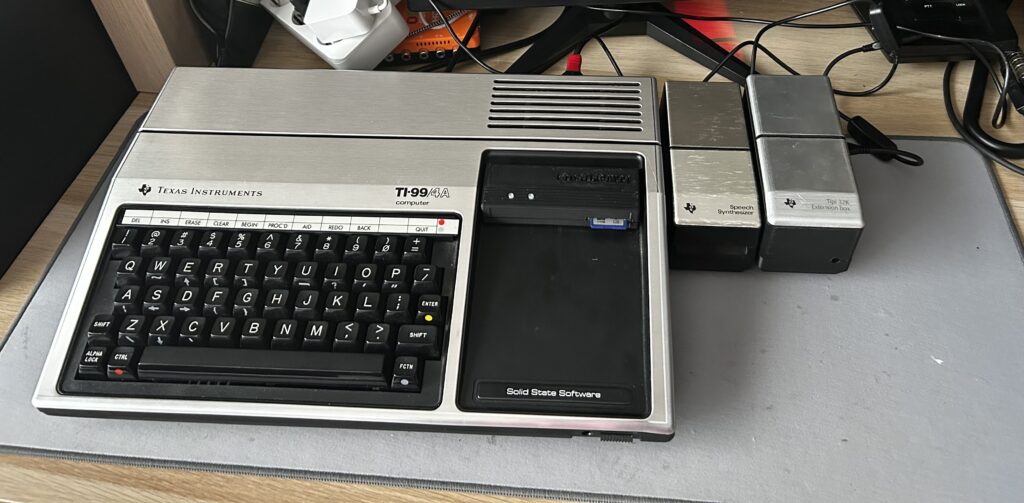
Because I can. And because I wanted to give this legendary early ‘80s machine a real, usable purpose. I have a fully working Speech Synthesizer, a solid TI-99/4A, and I wanted to plug in a modern brain through the TIPI interface — to connect it to files, network storage, or even AI.
But honestly, this was also deeply personal.
The TI-99/4A was my very first computer. I was 15. That’s where everything started. It’s the machine that gave me the tech bug, the one I used to write my very first programs — and yes, like many others, I started with:
10 PRINT « HELLO »
20 GOTO 10
This project is a tribute. A full-circle moment. A way to reconnect with what first made me curious, determined, and creative in tech.
The setup
I started with a Raspberry Pi Zero W, soldered the necessary GPIO pins by hand, and flashed the TIPI image. It didn’t boot — and for good reason: it was the image for the Zero 2W, not the W. Once I used the correct image, everything worked fine.
Later, I switched to a Pi Zero 2W and soldered the GPIO again — but something went wrong. The board was toast. Not even powering up. It happens.
So I went for a Pi Zero 2W with pre-soldered headers. This time, I connected it to the TIPI board using a clean 10-pin cable and modeled a second level inside the enclosure to securely clip the Pi on top, without soldering. It fits perfectly, leaving room for USB and HDMI cables through a side opening.
Now, everything is neat, modular, and rock-solid.
Why TIPI?
Because TIPI turns the TI-99/4A into something way beyond its specs. You can mount a virtual drive, serve files, interact with the network, and even create bridges to modern services — without altering the original machine. You keep the soul, but you unlock new capabilities.
It’s not about nostalgia — it’s about giving this machine a reason to exist in 2025.
And honestly, for the kind of I/O the TIPI handles, even a Pi Zero W is fast enough. I’ll soon move the setup to a 256 GB SD and test more advanced use cases.
What’s next?
Now that it all works… what can I actually do with it?
That’s the fun part. The TIPI is a gateway — I could turn the TI-99/4A into a custom retro dashboard, a dedicated AI terminal, a local status display for my home automation network, or just a showpiece that still talks, types, and reacts.
For now, it’s just satisfying to hear the familiar hum of the TI-99/4A screen and know that it’s alive again — and ready.