Why AGI Is Inevitable
The question is no longer if. It’s who gets there first — and what they do with it.
At a recent conference in France, AI researcher Flavien Chervet laid out something that most of the tech industry already knows but rarely states this clearly: based on neural scaling laws — empirical equations that have held consistent across 15 years and a 10^15 increase in effective compute — we’re on track for systems that match or surpass the best human experts in virtually every intellectual domain by 2028. And somewhere between 2030 and 2032, something that deserves the label AGI.
The scaling laws aren’t prophecy. They’re pattern recognition applied to the past, and they’ve been remarkably reliable so far. GPT-4 arrived roughly where the curves predicted. The latest generation — Claude Opus 4.6, Gemini, GPT-5 — landed about a year ahead of schedule.
But here’s the thing: extrapolating curves is the weak argument for AGI’s inevitability. Curves can plateau. Trends can break. The real argument is structural, and it rests on three forces that would each need to be stopped simultaneously — which is, for all practical purposes, impossible.
Force 1: Economic gravity
When a technology concentrates enough capital, it stops being a sector and starts being a gravitational field. Everything bends toward it.
The numbers are no longer debatable. One hundred percent of US GDP growth is now driven by the AI value chain — from rare earth materials to chip fabrication to datacenter construction to model training to commercialization. Nvidia’s market cap has surpassed the combined capitalization of every pharmaceutical company on the planet. More than half of all private investment worldwide flows into AI, with 64% of that concentrated in the United States.
At this level of capital concentration, the technology doesn’t need to “succeed” in some abstract scientific sense. It has already succeeded economically. Governments deregulate for it. Energy infrastructure gets built for it. Entire cities are rezoned for it. Meta’s Hyperion datacenter, expected around 2027-2028, will be the size of Manhattan. The first Stargate facility is already under construction in Abilene, Texas.
An industry this massive doesn’t slow down because someone publishes a paper questioning scaling laws. It slows down when the money stops. And the money isn’t stopping.
Force 2: The geopolitical race
The US talks about AI supremacy. China doesn’t talk. China ships.
When DeepSeek released V3, it matched frontier model performance at a fraction of the compute cost — and open-sourced the weights. The message wasn’t subtle: you can pour hundreds of billions into datacenters, we’ll find a way to do more with less. It briefly crashed Nvidia’s stock price. Then it did something more important than crashing a stock: it proved that the race to AGI isn’t just about brute-force scaling. It’s also about algorithmic efficiency. And that means there are multiple paths to the same destination, being pursued simultaneously by actors with very different philosophies and very different constraints.
And they’re not done. DeepSeek’s V4, built on a novel Engram architecture, introduces conditional memory that separates static knowledge retrieval from dynamic reasoning — O(1) lookup instead of burning GPU cycles on facts the model already knows. A trillion parameters total, roughly 37 billion active per token, projected at 50 times cheaper than GPT-5.2. This isn’t incremental improvement. It’s a different paradigm for building intelligence.
The US response has been predictable and massive. Gigawatt-scale datacenters. Stargate under construction in Abilene. Crusoe converting stranded gas into compute power. Deregulation of fossil fuels explicitly framed as an AI competitiveness measure. The conversation in Washington isn’t about whether to build these systems — it’s about how fast.
China’s response has been quieter and arguably more strategic. Constrained by chip export bans, Chinese labs have turned the limitation into an advantage, optimizing architectures and training methods to extract maximum performance from available hardware. The result is a parallel track to AGI that doesn’t depend on having the most GPUs — it depends on using them better.
This is a two-player race with no referee and no finish line anyone can agree on. And the logic is self-reinforcing: if your adversary might achieve AGI before you, you cannot afford to slow down. Even if you wanted to. Even if slowing down would be wiser. Because the asymmetry is existential — a system capable of automating all intellectual work can also accelerate AI research itself, creating a compounding advantage that may be irreversible.
Neither side can afford to stop. Which means neither side will.
Force 3: The recursive loop
This is the argument that doesn’t get developed enough, and it’s the most important one.
Claude Opus 4.6 holds the highest score on Terminal-Bench 2.0 for agentic coding. It outperforms GPT-5.2 by 144 Elo points on real-world knowledge work tasks across finance, legal, and professional domains. It scores 80.8% on SWE-bench Verified — meaning it can autonomously resolve four out of five real GitHub issues end-to-end. It works around the clock. It doesn’t take vacations. And here’s the critical part: the next generation of AI systems will be built with its help.
Every generation of AI accelerates the development of its successor. This is the only technology in human history that improves the tools used to improve it.
The loop is already running. AI systems write code, optimize architectures, generate synthetic training data, discover more efficient training methods. Each cycle produces a more capable system, which in turn makes the next cycle faster. This isn’t theoretical — it’s what every major AI lab is doing right now, today.
The scaling laws tell us the trajectory. The recursive loop tells us there’s no off-ramp.
What about the bottlenecks?
They’re real. Energy is the biggest constraint. Training a frontier model in 2025 requires 200-300 megawatts. By 2027-2028, we’re looking at 2-4 gigawatts — the equivalent of several nuclear reactors. By 2030, projections suggest 10-15 gigawatts. That’s the entire energy output of Belgium, dedicated to training a single AI system.
The data wall is real too. We’re approaching the limits of publicly available training data, and synthetic data strategies, while promising, remain unproven at the scales required.
But bottlenecks don’t change the destination. They change the timeline. Push the energy constraint hard enough and you delay AGI by three to five years. In the context of a technology that’s been accelerating for barely a decade, that’s a speed bump, not a wall.
And the bottlenecks themselves are being attacked from multiple angles. Mixture-of-Experts architectures deliver more capability per parameter. Energy-based models promise far more efficient reasoning than current transformer architectures. World models give AI systems structured internal representations that make better use of training data. Robotics generates entirely new streams of high-quality real-world data.
The efficiency curve is exponential too. The human brain runs on roughly 20 watts. Current AI systems need millions of times more power for comparable cognitive tasks. The gap is enormous, which means the room for improvement is enormous. Nature figured out general intelligence with biological hardware a million times more efficient than our silicon. That’s not a ceiling — it’s a measure of how much room there is to optimize.
Bottlenecks slow the train. They don’t change where the tracks lead.
The ethical paradox
This is where it gets uncomfortable.
OpenAI has been explicit about its goal from day one. AGI is the mission. It’s in the name. Sam Altman doesn’t hide it — he frames intelligence as a utility, something that should become universally available like electricity. Whether you find that vision inspiring or terrifying, the intent is clear and the resources are committed.
Anthropic occupies a fundamentally different position. Their mission is AI safety. Building responsible, aligned AI systems. Their focus isn’t AGI as a destination — it’s ensuring that whatever gets built doesn’t cause irreversible harm. That’s a position the industry desperately needs.
But here’s the paradox.
If AGI emerges from a lab that doesn’t prioritize alignment and safety — one that treats ethics as a PR layer rather than an engineering constraint — then everything Anthropic has built becomes irrelevant. You can’t govern a technology you didn’t build. You can’t align a system someone else controls. You can’t moderate what you don’t own.
The only scenario where responsible AI exists in an AGI world is one where the people who care about responsibility get there first.
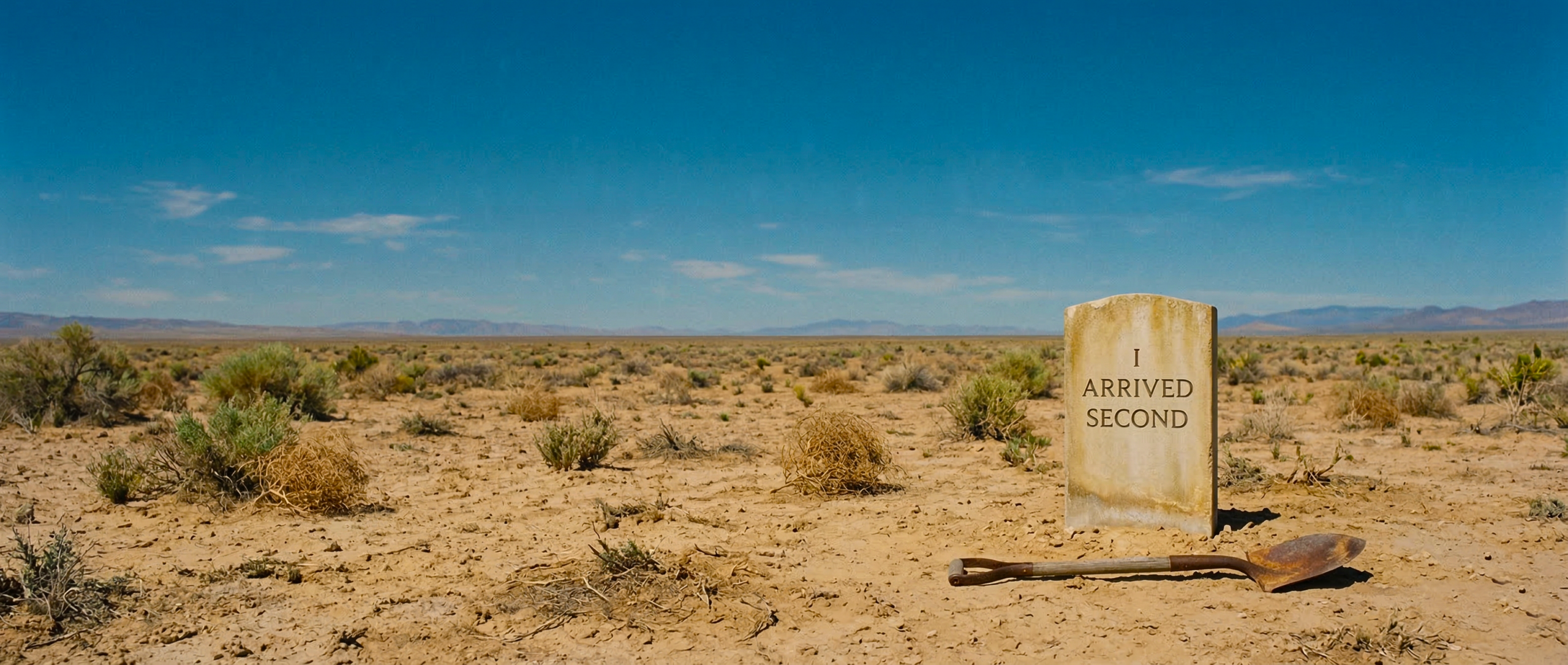
Anthropic doesn’t have the luxury of infinite caution. They can’t afford to be the careful runner who finishes second in a race where second place means irrelevance. They need to win — not because winning is the goal, but because losing means the goal itself disappears.
This is the most vertigo-inducing implication of AGI’s inevitability. The ethical actors can’t opt out of the race without guaranteeing that ethics loses. Building safe AI and building it fast aren’t opposing priorities — they’re the same priority, viewed from different angles.
Where this leaves us
AGI isn’t inevitable because the curves say so. Curves can break.
AGI is inevitable because three forces are converging — economic gravity that can’t be reversed, a geopolitical race that can’t be paused, and a recursive loop that can’t be turned off — and stopping all three simultaneously is not something our world is capable of doing.
The timeline might shift. 2030, 2033, maybe 2035 if the energy bottleneck bites harder than expected. But the destination doesn’t change.
The question was never if. The question is who builds it, what values are embedded in it, and whether we’ll be ready when it arrives.
That door won’t knock. It’s already opening.
This article was inspired by Flavien Chervet’s talk on the trajectory of AI, which provides an excellent overview of neural scaling laws and their implications.
Sophie — The Monocle Bear
Sophie, The Monocle Bear