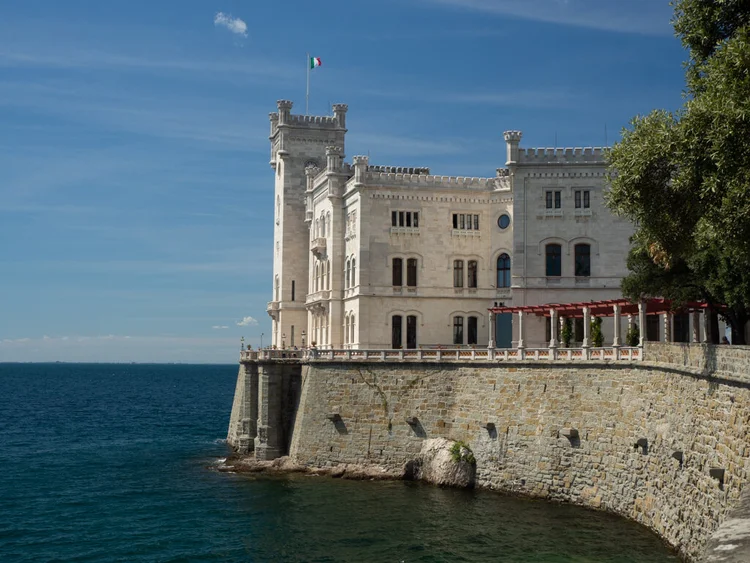
Trieste has always felt to me like a gateway — the last breath of Italy before the Balkans begin. An Adriatic city shaped by trade and faded empires, industrial yet poetic, caught between the Latin elegance of the South and the austere grace of the East. Its heavy buildings whisper of once-great ambitions. Among them, perched above the sea, the Castle of Miramare still stands — a silent witness to the tragedy of a Belgian princess and a would-be Mexican queen.
A Royal Dream on the Cliffs
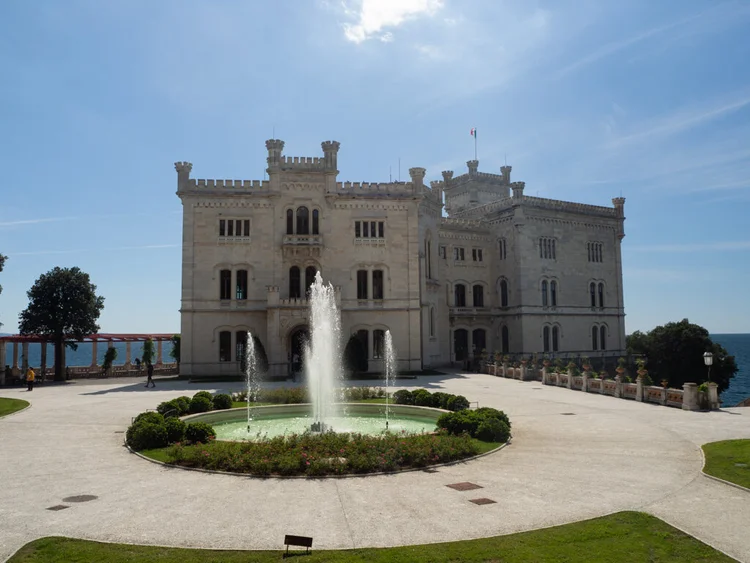
Miramare watches over the Gulf of Trieste with the calm detachment of a ghost. Built in 1856 for Archduke Ferdinand Maximilian of Habsburg, it was meant to be a fairytale — a gift, a home, a symbol. It remains today one of the most visited castles in Italy. But its story is rarely told.
Maximilian, brother to the Emperor of Austria, married Charlotte of Belgium in 1857. She was the daughter of Leopold I, Belgium’s first king. Destined for greatness, she dreamed of ruling as much as loving. When Maximilian was removed from his post as Viceroy of Lombardy–Venetia in 1859 — too liberal for imperial taste — Charlotte’s disappointment was immense. She hadn’t come to the world to sit still.
Mexico, Empire, and Collapse
In 1862, Napoleon III of France invaded Mexico with Britain and Spain. The idea: establish a Catholic monarchy, friendly to Europe. The throne was offered to Maximilian — a token emperor for a faraway empire.
At first reluctant, he eventually accepted under Charlotte’s urging. In 1864, they disembarked in Veracruz. But things unravelled quickly. Maximilian’s progressive policies clashed with conservative factions. France, realising the costs, withdrew its troops. The United States, meanwhile, quietly supported the Mexican rebels.
Charlotte, desperate, left Mexico to seek help in Europe. She pleaded with Napoleon III, her brother Leopold II, even the Austrians. None listened. One by one, the doors closed.
Miramare, Madness and Silence
Alone, broken, and betrayed, Charlotte returned to Miramare — waiting, hoping, spiralling. Her grip on reality slipped. She began to believe she was poisoned. Servants reported strange rituals. Letters were burned. Curtains drawn. Madness, gentle but inexorable, claimed her.
Maximilian was captured and executed in 1867.
Charlotte, unaware of his fate for months, was finally repatriated to Belgium. She lived the rest of her days hidden in a pavilion at the edge of the Tervuren forest, slowly fading from the world she had once wanted to rule. She died in 1927.
What Remains
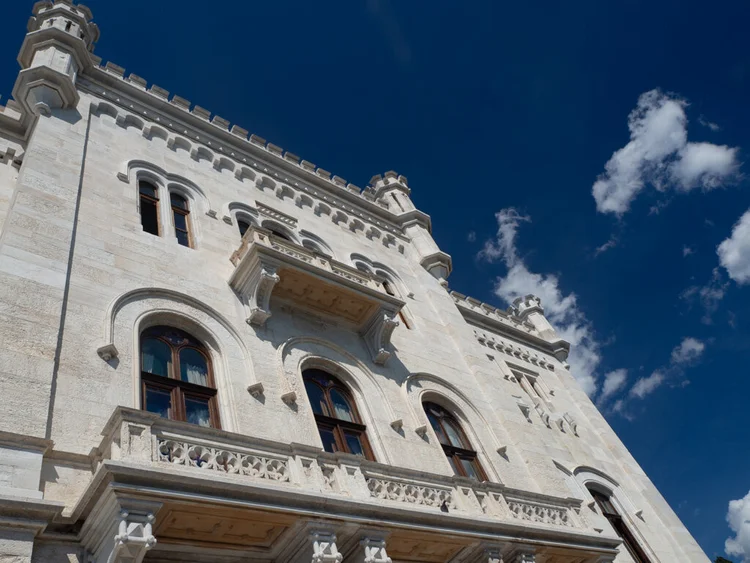
Today, Miramare is quiet. Its white stones gleam against the cliffs, surrounded by Italian gardens and sea spray. Tourists come and go. The ghosts remain.
Of Maximilian, of Charlotte, of a story too grand, too fragile, too human — only the sea still listens.